Imaging neural circuits in Danionella
Understanding a neural circuit requires observing its activity while the animal senses and responds to its environment. Danionella offers an unusual opportunity to do this in an adult vertebrate: the fish is only about 12 mm long, remains transparent throughout life and has no skull roof above the brain.
Unlike many transparent larval models, adult Danionella displays mature social and sensory behaviours. Its small brain and optical accessibility make it possible to study these behaviours while retaining a view of neural activity across a substantial fraction of the brain. Our question is how distributed neural activity represents the physical cues that allow the animal to localize sound.
Why Danionella
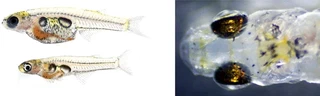
Adult female and male Danionella translucida. Image extracted from Schulze et al. (2018).
Schulze et al. described an adult brain of approximately 0.6 mm³ containing an estimated 650,000 neurons. They established genetic manipulation with CRISPR–Cas9 and Tol2 transgenesis, and demonstrated calcium imaging in transgenic fish expressing GCaMP6f. Two-photon imaging reached about 300 µm into the brain—nearly half its volume—while the animal remained capable of adult behaviours such as courtship, shoaling and acoustic communication.
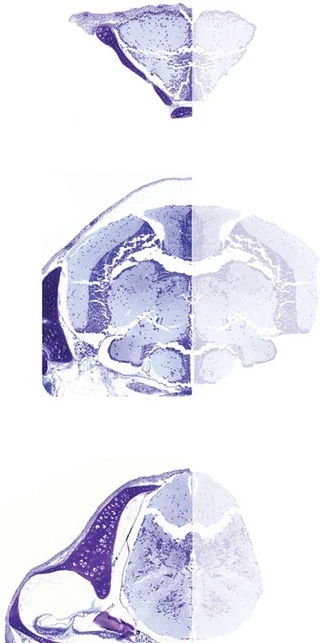
The transparent head and absence of a skull roof provide direct optical access to the adult brain. Image extracted from Schulze et al. (2018).
A tractable question: directional hearing
Sound localization is particularly interesting underwater. The pressure difference between the two sides of a small fish is too weak to provide the cue used by terrestrial vertebrates, yet fish can still determine where a sound originates.
Work in Danionella cerebrum showed that pressure and particle motion are both required for directional hearing. The swim bladder and Weberian ossicles provide an indirect pressure pathway to the inner ear, while the otolith organs sense particle motion directly. Their relative phase carries directional information. This establishes a well-defined sensory computation that can now be followed from the mechanics of the ear toward its neural representation.
Research direction
For our group, Danionella provides a compact biological system in which new optical and photoacoustic methods can be developed against identifiable sensory signals and behaviour. Our aim is to connect measurements of brain activity with the physical sound cues available to the animal, and to determine how distributed neural circuits represent and use directional information.
Working with us
This project brings together optical imaging, underwater acoustics, behaviour and systems neuroscience. It is particularly relevant to collaborators with Danionella genetics or neurobiology expertise, and to prospective researchers who want to connect instrument development with a precise biological question. Contact us to discuss complementary approaches or a possible project.
References
L. Schulze et al., Transparent Danionella translucida as a genetically tractable vertebrate brain model, Nature Methods 15, 977–983 (2018). J. Veith, T. Chaigne et al., The mechanism for directional hearing in fish, Nature (2024).
