Dual-comb optical ultrasound sensing
A Fabry-Pérot ultrasound sensor is extremely sensitive, but its resonant wavelength changes slightly across its surface. Reading a large sensor with one narrowband laser therefore requires repeated wavelength tuning. We use two optical frequency combs instead, so that many wavelengths can interrogate the sensor at the same time.
In our first demonstration, three optical channels recorded a 10 MHz acoustic wave in a single shot with 20 ns temporal resolution. We are now developing this principle into a spatially resolved readout for faster, high-resolution all-optical photoacoustic imaging.
Why two frequency combs?
A frequency comb is a set of evenly spaced, mutually coherent optical frequencies. When one or more comb lines lie on the slope of a Fabry-Pérot resonance, a pressure-induced resonance shift modulates their reflected intensity.
A second comb with a slightly different spacing converts the optical signals into distinguishable beat notes at radio frequencies. Each useful pair of comb lines then acts as a separate measurement channel. The system can retain the fast response required for ultrasound while covering a much broader optical range than a single narrowband probe.
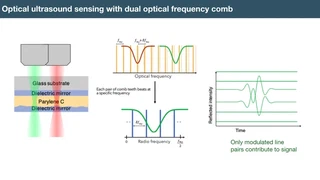
Comb-line pairs that overlap a resonance slope carry the acoustic modulation. Diagram from the project presentation dofc.pptx.
What has been demonstrated
Our electro-optic combs are generated from two narrow-linewidth lasers using intensity and phase modulators. In the first experiment, their repetition rates were 10 GHz and 9.95 GHz. Approximately thirty lines covered a 300 GHz optical span, chosen to accommodate realistic resonance variations across a thin polymer sensor.
The combined light interrogated a Fabry-Pérot cavity while a transducer generated a 10 MHz acoustic burst. A balanced photodetector recorded the dual-comb interferogram, whose radio-frequency components were separated by time-frequency analysis.
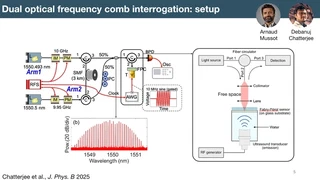
Experimental arrangement used for the proof-of-principle measurement. Diagram from dofc.pptx, based on Chatterjee et al. (2025).
This experiment provided a single-shot measurement of a 10 MHz acoustic wave through three simultaneous optical channels, with a temporal resolution of 20 ns. The recovered waveform agreed with a conventional continuous-wave reference measurement. It establishes that sensor resonances separated in wavelength can be monitored together, without retuning the probe between measurements.
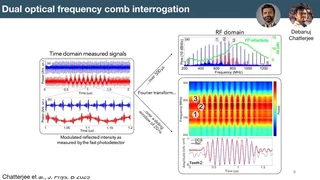
The optical interferogram is mapped to radio-frequency channels, from which the acoustic waveform is recovered. Results from dofc.pptx, based on Chatterjee et al. (2025).
Current direction
The present result demonstrates the spectro-temporal principle at one position on the sensor. We are now working to improve sensitivity, refine the balance between comb spacing and acoustic bandwidth, and integrate the method into spatially resolved photoacoustic acquisition. Parallel or compressed interrogation could ultimately reduce the time needed to map a complete ultrasound field.
Working with us
The project connects electro-optic frequency-comb generation, low-noise optical detection, Fabry-Pérot sensor physics and fast acquisition. It is suited to collaborators and prospective researchers interested in taking a precise spectroscopic result toward a complete imaging instrument. Contact us if your expertise or application could help test that transition.
Reference
D. Chatterjee et al., Real-time electro-optic dual comb detection of ultrasound waves, Journal of Physics B: Atomic, Molecular and Optical Physics 58, 153501 (2025).
